
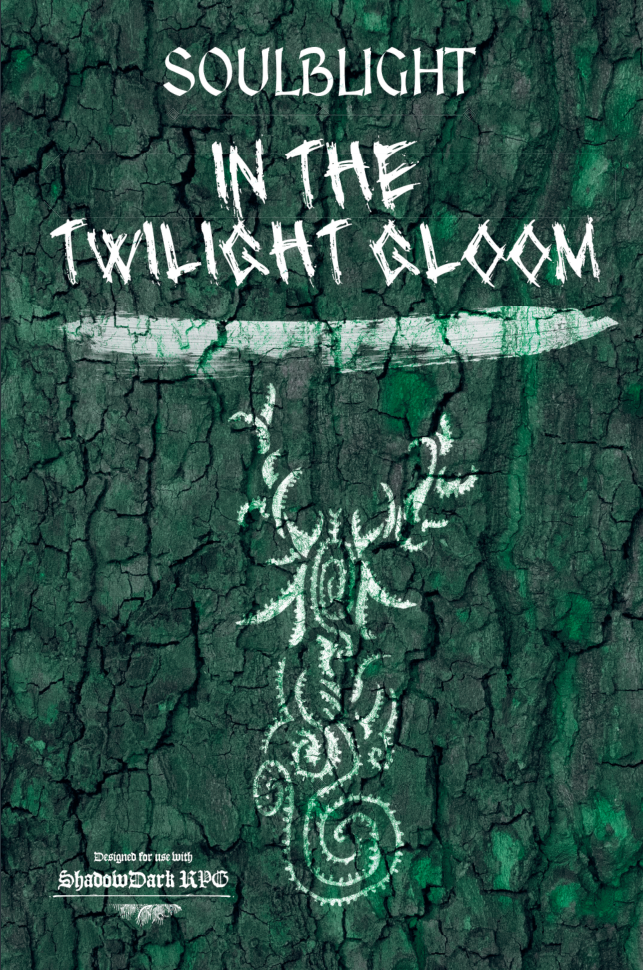
Soulblight – In The Twilight Gloom can be found on Itch for $9.00. 139 pages, A5.
Hex crawl in the Cursed Scroll format. No dungeon crawl.
~ 2000 words. ~10 minutes read time.
Full disclosure: I know the author. Laurin & I talk shop, advise one another, & promote each other’s work. I reviewed Adamant Crown back in April, and the same goes here: I may come across harsher because of our friendship. There were attempts to bribe with a free review copy. It was rejected because I had already paid for it.
What is it?
A folk-horror mini-hexcrawl for Shadowdark, centered on a nameless lake, a single village (Pynemere-by-the-Lake), & an isle wrapped in fog. Writing, design, & art are by Laurin-David Weggen, with layout by Taylor Seely-Wright. It’s a Soulblight book, so it plugs into his setting, but it says no other third-party material is required meaning you don’t need the Soulblight books to play it. Which, that’s consistent with other Soulblight offerings in that they’re all self-contained.
It suggests the Witch, Warlock, and Ranger from the Cursed Scrolls as options.
It’s built in five chapters: the region (character options, factions, faces, folk legends), gameplay (the Mist, major, minor and wandering hex keys, random encounters), the three big entities, a bestiary, and treasure. You’ll note, there’s not a dungeon in that list.
Unique Features?
This hex crawl is inspired by American folklore for cryptids from the Pacific Northwest & Appalachian region. So obviously you need…
…The Mist. When it rolls in, every hex becomes Deadly, it gets to leave the isle, resting gets harder, & an exposure table ticks up by the hour, from DISADV on sight checks through WIS damage to… worse. That’s a tension timer the players can see & feel. It makes shelter (and light) matter, which is exactly what Shadowdark is good at.
Character options. Vessels (read: transport), Engulfment (read: ritual talent), & Forgotten Hexes (read: tier 5 spellcasting anyone can engage) give the PCs.
Ciphers. Number strings & letter ciphers are scattered through the page margins. There isn’t an easy way to share them & there is no quick cheat sheet for what they say. You’ll need to spend some time with it as part of your prep. (I’m convinced some of these don’t decode.)
Wandering hex keys. Locations that move. Great idea for a hex crawl where the woods are “ever-changing.” This is the juice.
What’s the story?
Something ancient lives on the isle & refuses to die. Something else has come to put it to rest, whatever the cost. A scholar wants to explain every mystery away. And, the village has its own secrets. That’s the triangle: three big entities, each a foe or an ally depending on what the PCs choose.
So… Adventure?
Setup
First, you need to understand this is a hex crawl adventure, not a dungeon. You are engaging the location & the factions more than treasure diving tomb raider style. It’s a different playstyle than standard Shadowdark so you’ll want to read to prepare to run this adventure. Thankfully, it has some fiction to help provide direction.
Second, you want to take some time to read the inner cover and map. The inner cover includes rumors, treasure, & search for secrets (quests) and it points to specific sites on the map. It’s explaining this is a sandbox with ideas seeded. This map is the adventure. There’s numbers on the map’s borders but since there is a blur or erase effect applied to it, you can’t really see it. Lots of great ink over pencil layering. I do have a nitpick about the image treatment, but it waits.
Third, while this says it is compatible with the quickstart rules and recommends certain classes for their flavor, I’m going to recommend not using the overland travel rules on page 14 of the Game Master’s Quickstart Rules and instead point you to the new Western Reaches travel rules (also found in Cursed Scroll 4). They’re better and provide more guidance & activities that I feel this adventure needs to feel complete. It allows the horrors and creepiness to soak in better.
Finally, there’s a bunch of factions, NPCs, & boogeymen. While I think you could play this without most of the character options and it would be fine. You really need to understand the factions for this to work. It would kind of help if there was a map of hex influence so you could see which regions of the map they’re meant to control at the start, but it’s okay without them. Just a little more prep work.
Hex Keys
There’s a little bit about how the Mist works before you get to the hex keys on page 48. The only reason I’m bringing up the page number is because I want to emphasize how this involves a lot of social interaction play thanks to the numerous factions & NPCs. Again, this isn’t your typical dungeon crawl.

Major hexes get a page each, sometimes more, usually with a d6 table attached (treasure, encounters, training). They’re dense with enough material to build a solid encounter from them. A farmhouse isn’t just haunted, there’s a reason it remains haunted, and there is a way to stop it. A mill and a lodge both sell training for gold and time.
Levers everywhere: shrines to make offerings at, things to steal that you shouldn’t, NPCs who want specific things (one wants secrets and true names), and creatures you can bargain with or banish. Some keys lean on prose over structure: the information is there, but obvious/hidden/secret isn’t always in that order, and some key details sit in the middle of a paragraph.
Okay, but… there isn’t really a throughline between the hexes beyond the theme – cryptids. The haunted farm doesn’t really connect to the starfall well doesn’t connect to the wicker ruins, etc.
If you like sandboxes, this is as unbounded sandbox as it gets. To me, that’s part of its problem. I find sandboxes work best when there is a goal or a handful of fully fleshed-out locations to engage in. This is why a lot of the recommendation for running sandboxes tends to be to have 2-3 modules to run & seed them into the location, then, expand it by another 2-3 modules when one is completed. With this structure, you see themes and connections develop over player choices.
In a thematic hexcrawl, I think you need to provide those strong options. One or two fully developed aspects that you put together as if they were dungeon crawls. Here’s the setup, rumors, hooks, factions, beast, the hexes that are at play, go find and resolve it. That tight aspect is what I think this is missing and what you will need to prep. The good news is you have most of the tools to prepare it.
This is a common complaint leveled at Hot Springs Island. Dense, full of adventure, you have to write the adventure. While I don’t mind doing that level of work, it helps if you have a million tools to do it and an afternoon to flesh it out. Hot Springs Island has fewer hexes overall & provides more so it is easier to build from, but this is in the same vein.
So who is this for?
This is for GMs who like folk horror, weird woods, and sandboxes with factions and ancient things that don’t care about the players. Wendigos, Mothman, Big Foot, & Skinwalkers make for an odd mix of American cryptid folklore, but it’s worthwhile to remember that the absurd is a contrast that makes the horrifying scarier, because some of the contrast between the various threats can have a similar jarring effect. Star crystal worshippers vs. murdering ghosts. Is it realistic? Yes. Does that make it stronger? I’m not sure it does.
It reminds me of Gabe Newell talking about the development of Half-Life 2 and someone mentioning that the improvement they were advising made things more realistic & his question was essentially, yeah, but does it make it more fun? I make lists all day, but I don’t put them in games to make the game more realistic. This isn’t a situation where it’s that extreme, but I do wonder if it had a tighter narrative arc at its core if this would be more appealing to a wider audience.
It’s right in my taste, so weigh that. If you want something to run tonight, this isn’t it. It’s a region to live in for a few months. This is an adventure you want to read, let marinate, & then plan around.
If you made it this far, thank you. Now, I’m going to nitpick & nerd out on design. You have been warned.
Design Nitpicks
It does its own thing. A misty black treeline bleeds down from the top of every page, black header bars run over the tables, and parchment notes and the author’s own ink illustrations are tucked into margins. It feels like a found journal.
DCs. Mostly 12 and 15, which is good. Lots of spellcasting DCs as well.
Treasure XP. Lots of treasure tables with gold values (thank you), but no XP noted.
Editing. There are typos that slow the read: “grea mill wheel,” “A small next to it hosts a single donkey,” “tot he Mist,” “If they banished.” Not deal breakers, but at this size they add up.
Also, you have a bunch of ciphers without translations or handouts. Some seem relevant, others not so much. It gives the feeling of an artifact which is fun for the GM, but at the same time, it seems incomplete because how do I use them for my players? Do I use them for my players? Or are they just filling space?
Layout. Okay. All art is by Laurin-David Weggen, and it’s moody and personal. Layout by Taylor Seely-Wright is cleaner than Adamant Crown. So we’re operating with the same team and this is vastly improved from Adamant Crown‘s layout. But it does have some obvious flaws that I couldn’t unsee once I saw them.
I love the treeline at the top of the page. It creates tension by being upside down. It conveys things not being what they seem. The font probably could use a stroke to make it stand out against the gradient’s light areas.
If we go back to the hex key, you’ll see one of my issues I think. Actually, let’s zoom in.
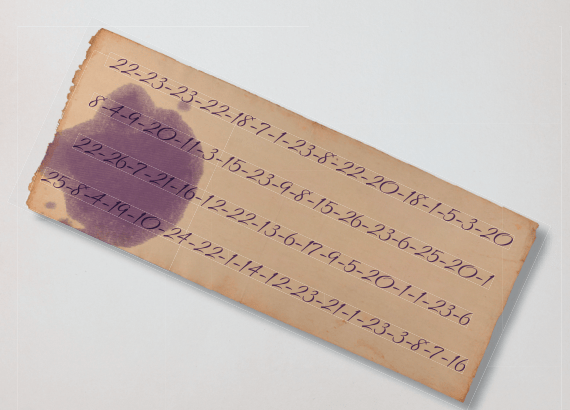
There’s a white stroke line around the parchment (you can see it in the shadow) & around the text lines. This occurs on every note like this throughout. I think it’s a .2 weight stroke that can easily be erased by setting it to 0.
Then, there are the images. They aren’t treated similarly throughout at all. Some are chiseled to have a painted effect.
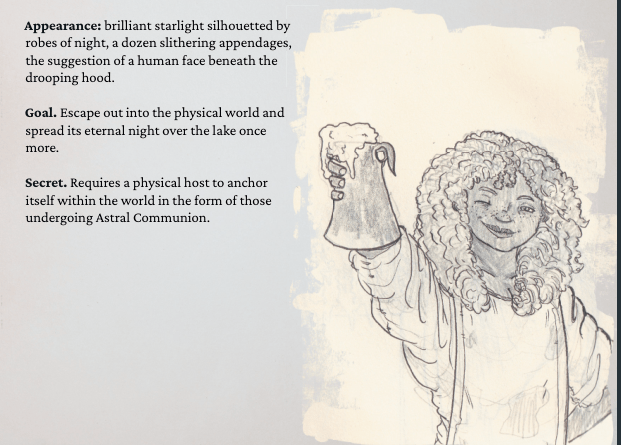
Some are given an opacity erasure (when you lower the opacity of the eraser so it doesn’t completely erase the image to give it a fading effect).

Some are just left as rectangle cut-outs of the image.

Regardless, all of this gorgeous art is treated in a variety of ways, but none of them are blended into the paper with the multiply or similar layer effects to darken the line-art and make it look like it is part of the page in the book. But the bloody, scratched-up ciphers are.

I don’t really understand why it’s not consistent throughout and it’s the first thing I would change. It’s one of the few things Beach Sorcerers does well. They are consistent with their treatment of the art so it’s always sharp & part of the page.
There are a few pages with padding & alignment issues that I would also want to address, but they are far fewer than what I found in Adamant Crown so it’s a sign of vast growth & improvement. Much appreciation & respect for that.
If you liked this review, Idle Thoughts is my free newsletter: new reviews, tools and peeks at what Idle Hands is making, twice a month. Sign up and you’ll also get Vigil, a free level 4 dungeon crawl for Shadowdark RPG. [Sign up here].
Leave a Reply