

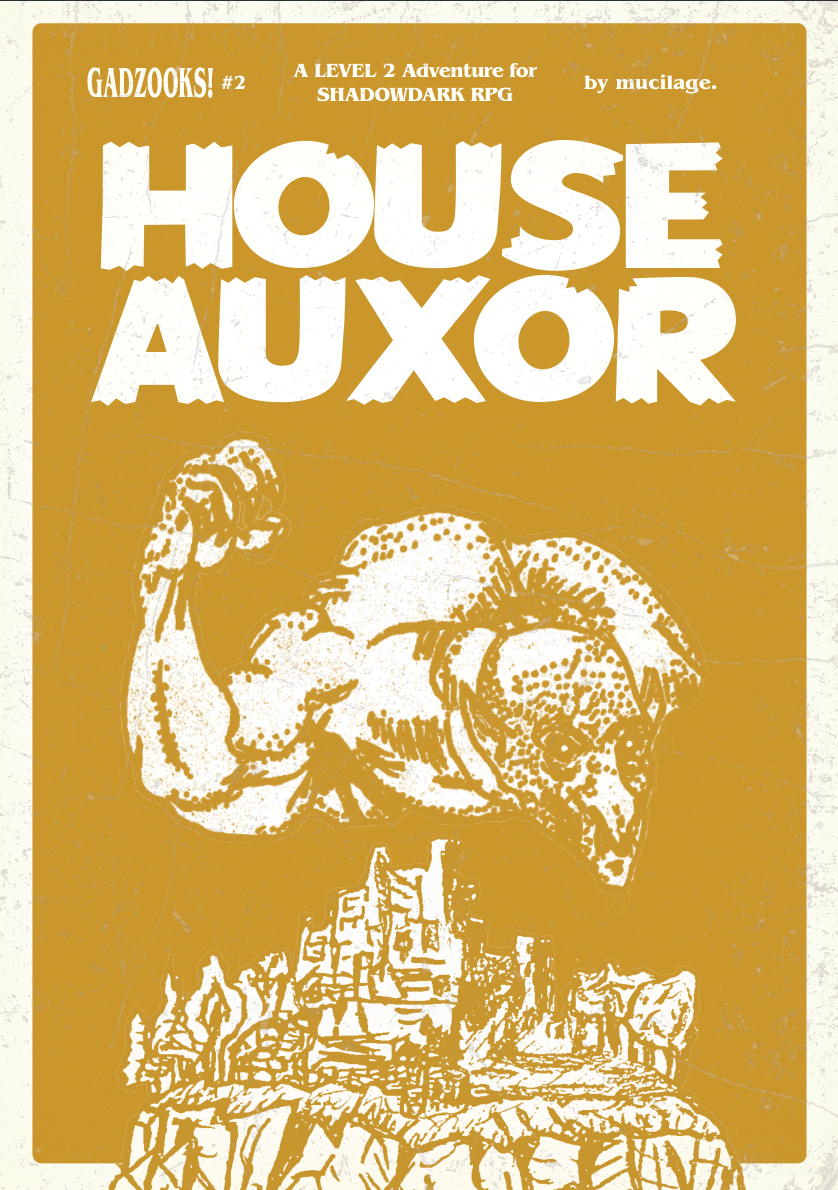
House Auxor can be found on Itch for PWYW. It suggests $2, so that’s what I did. You can also snag it off DTRPG. 16 pages (cover, 14 interior pages, back cover). Level 2. ~ 2000 words. 10 minutes to read.
I originally saw this on Reddit when it was first published back in June. The cover drew me in. Oh, something different from everything else that’s black & white. I’m intrigued. The mockup & presentation are very slick. There’s a designer behind this and it appears they are trying to launch a zine series. Again, intrigued.
What is it?
This is a Shadowdark adventure for level 2 characters, and it’s the second entry in mucilage’s GADZOOKS! series, which the back cover describes as “a series of 1-3 session place-based adventure modules inspired by the fanzines of early fantasy roleplaying.” It’s a 20-room, two-level dungeon crawl through the rotting palace of a curio-collecting noble family.
Unique Features?
For the most part, there are no special mechanics to this. It’s a fairly straightforward, fun location to drop into your sandbox.
And it has its own aesthetic. I do have to say though, there’s a troll who chews gold & that’s fairly unique and fun.
What’s the story?
A century ago, House Auxor raided a sorcerer’s lair. His dying curse wiped out the bloodline, except Prince Matyas, who is slowly turning into a troll. His loyal servants, the nebellem, can’t fix him. Their arcanist, Drulfor, has burned through the treasury on failed cures, so he hired sahuagin raiders to plunder the coast for gold. Now the sahuagin want their pay, and their warlord Vorka is thinking about taking the palace.
So… Adventure?
Setup
We get 2 hooks, 2 rumors, a d6 random encounter table, light, and danger level, all on p. 2. “Light. Areas 6 & 16 open to outside. Otherwise dark.” and “Danger level. Unsafe. Check for random encounter every 3 rounds.” Thank you. That’s the Shadowdark basics in two lines. It’s also the entire backstory, random encounters, rumors, hooks, light, & danger level on 1 page. The next two pages are factions, NPCs, order of battle, and monster stat blocks. Along with the map on page 1, that’s the entire setup in 4 pages. That’s solid. Also, terse.
The hooks give you two different reasons to show up: a letter from Drulfor asking for help curing the prince, or the Fishing Guild offering 500gp to stop the raids. Those point you at opposite factions, which I like. You’ll have to find a way to weave them in, otherwise, they kind of become jobs on the bulletin board at the local adventuring guild.
Only 2 rumors, though. A d6 would’ve been nice, and this place has plenty of material to fill it out. I tend to think a d4 is the minimum, but a d6 should be the aim for a small dungeon like this. Players need to be able to gather information before engaging the adventure to some extent. It’s just part of the core ethos of Shadowdark and the OSR with regards to giving information freely. You sort of need information to give.
The random encounters are active. Panthers hiss at “the nearest light source, calming when dark,” and golems flee a spider swarm. Two of the six results are Prince Matyas, though, and he’s an LV 6 regenerating troll against level 2 PCs. So, while it is a little heavy per the SD 1:1 monster math, it’s survivable. I tend to run deadly encounters when I prepare them, so I would reduce Prince Matyas’s chances of appearing, but since this is Unsafe, you may only get 1-2 random encounters the entire dungeon so it’s okay. More on that later.
Page 3 gives us factions (nebellem and sahuagin), key figures, and an Order of Battle: how the nebellem herd intruders toward exits and converge on Matyas, how long Vorka needs to rally a horde (1d6 rounds), and how Matyas wanders when he leaves Area 20. That’s the kind of thing that makes a dungeon feel alive and highlights what separates TTRPGs from video games.
The creatures follow on the next page, with new monsters and page references to the core book for sahuagin, spider swarm, and panther.
Room Keys

Each entry has a short description up top with key words highlighted. Those words show up underneath as » bullets, with ▶ sub-bullets for consequences. It’s clean and easy to scan. Mostly it goes obvious, then hidden, then secret. Area 1 has debris, then paintings, then gold, then the one-way secret door. Underlining the bolded terms is a bit overkill, but it’s fine. It’s not applied consistently in the bullets, though, which isn’t a game-breaker but an opportunity for improvement. There’s something about the sidebar on the description and colored background that makes me think this was designed in LaTeX.
The minimap is included on each spread (2 pages) and while small & a little difficult to read, it’s fairly straightforward. Maybe in the future, the monsters could have their own shape like the L for locked doors so it can be understood visually when the font is too small to read effectively. Some of us have old eyes.
There are lots of levers to pull:
- Hall of Candles (Area 3). “If any candle is lit, all candles ignite simultaneously, starting dim and culminating in a blinding flash.” The flash puts out every light. Great torch trap, in a game where the torch matters.
- Forgotten Shrine (Area 4). Clean the altar or show respect and you get provisions. Grab the coins first and Lady Auxor will be suspicious of you later in Area 6. That’s a consequence that carries across rooms. Love that.
- Etc.
There are also a few quiet rooms. The Sitting Room (Area 15) is couches that puff dust. They’re small, but they do something. But I’m not really a fan of empty rooms. I should clarify this because I know some people think differently: if a room contains lore, I don’t think it is empty. If there is no meaningful interaction, it is empty. Some people like them as breathers between action; I think passive rooms that provide nothing unless you interact with them do the same thing. So, if you include a room with absolutely nothing, you didn’t finish your dungeon or worse, you’re wasting space & my time.
After the area descriptions, we get the “concluding the adventure” section, helpfully named something briefer (and I may steal this wording), Followups. The Followups provide good ramifications for how to progress the story after the players complete it. It explains how it should impact your world. The options aren’t breaking any new ground here, but it’s rare to see and their inclusion is great in and of itself. That’s an author who thinks the adventure should continue even after it concludes.
While prepping this, I didn’t have to make many changes. It’s pretty well written for a short, simple jaunt. It’s a reminder for myself that simple works and I don’t need to always have complex adventures (although I do love a lot of great faction play with noble houses & backstabbing drow).
So who is this for?
Honestly, this is for anyone who likes a dense little dungeon with factions to play against each other and a tragic monster at the center. It’s for GMs who want to run tonight, but you’ll want to add XP for the treasure, maybe soften the troll for a level 2 party (dial it to fit your table), and add a couple more rumors. It’s free/PWYW, so it’s a no-brainer to grab.
/Newsletter callout
If you made it this far, thank you. Now, I’m going to nitpick & nerd out on design. You have been warned.
Design Nitpicks
It does its own thing. No Shadowdark trade dress here. It follows the minimalist form and that’s about it. It’s mustard gold, white, and black, with chunky display type, numbered keys tagged with color, and bold callouts. It does this while still maintaining Shadowdark’s minimalist aesthetic. Hell yeah! This is what I keep asking for & encouraging.
I do hate ▶ that don’t point to a direction, but that’s a personal beef. I’m not going to hold it against anyone. I think there are better bullet options.
The best detail for me: every spread has a minimap of the rooms on that spread (see above). The full map is up front on p. 1, sitting right next to the overview, hooks, rumors, and random encounters. That puts the map before the keys, and you get reminded where you are while you run it. (Tell them what you are going to tell them. Then, tell them.) Love it. The minimaps do get a little small so some of the details included on them get difficult to read at the small size, but it’s okay. That can be managed.
DCs. Almost every check is standard: heavenly. I’ve said it before and I’ll say it again, the standard DCs are a clever trick to make running the game easier & faster because it makes the distinction between them more apparent. 1-point increments eliminate that clarity and slows gameplay down with option paralysis.
Checks with costs. Most checks have real consequences, like falling, blindness, or the troll showing up. The Spiral in Area 19 is the weakest one: “DC 9 INT or bump into a wall, dealing 1d4-1 damage”. That’s a roll for 0–3 damage. It’s flavor, and I’d make it a description, or make the bump loud enough to trigger a random encounter check.
Treasure XP. Treasure values are in the keys (gp everywhere, which I appreciate), but XP isn’t noted anywhere. With this much gold, from the 268 gp treasury (p. 10) to 3 pouches of gnawed gold at 100 gp each (p. 13), I’d write XP in the margins. It just helps orient GMs. It’s something I’ve started doing and sort of want to see other authors do as well.
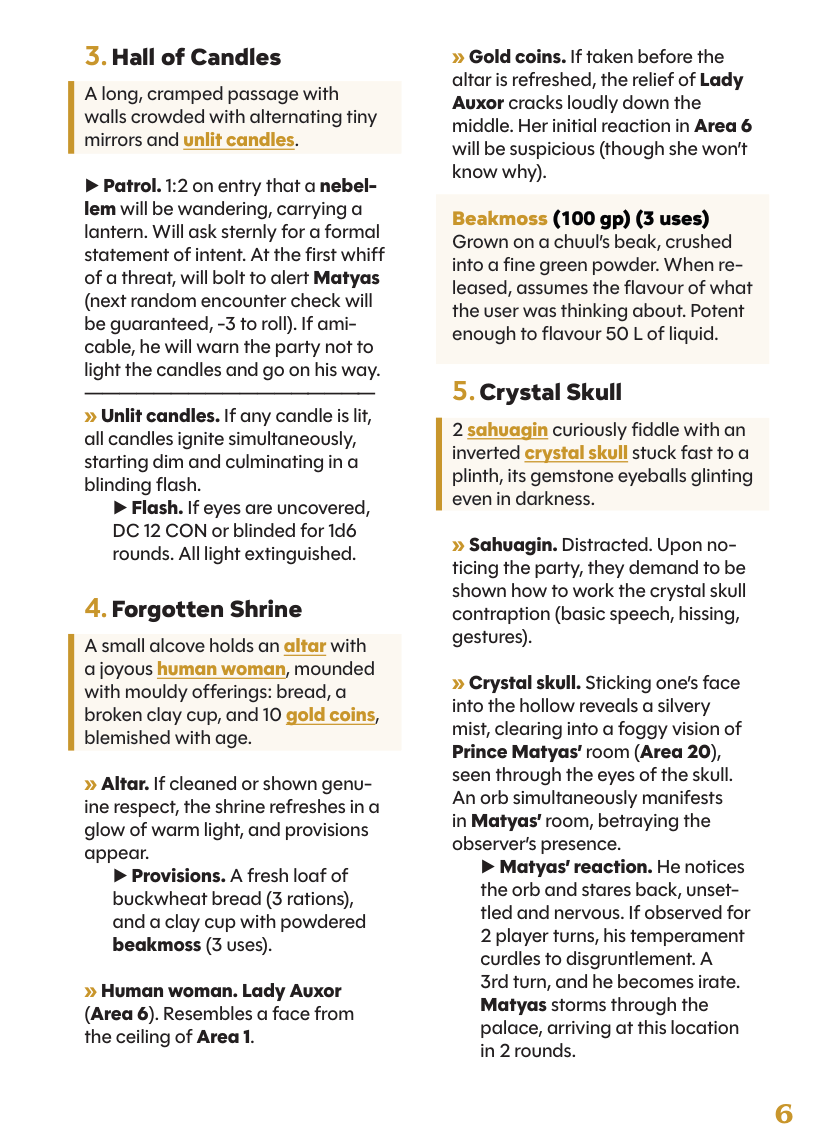
Layout. There are minor breaks across columns. Area 4’s gold coins and beakmoss continue at the top of the next column, Lady Auxor’s stat block splits off from Area 6, and Area 8’s gold and sphere continue in the next column. These are all on the same spread, though, so there’s only minor page flipping. While I approve of the console spread that most people use when making their zines, I think people forget PDFs tend to read 1 page at a time. Lots of people read on their phones or tablets so column breaks & page breaks require more scrolling to keep track of. It’s an inconvenience to your user.
Page numbers & bookmarks. It has page numbers. No bookmarks. At 16 pages, the minimaps do much of the navigation work, but bookmarks are bog standard for a PDF. It’s digital. If it’s the final version, I expect PDF interactivity. I forgive it on free products, but bookmarks are the bare minimum. I use internal linking a lot because I don’t use minimaps (more room for words) but even just links to the monster stat blocks would be nice.
Art & credits. The cover troll is great, and the spot illustrations (like the spiders on p. 5) carry the zine look. The itch page says “No generative AI was used.” It doesn’t list the artist, but I’m going to presume it is the author since there is no credit for anyone else. And it is very charming.
I recently released the playtest of Hubris of Blood. It is currently very bloated with a lot of ideas from the campaign I want to build from it, so expect it to be streamlined, but I want to know what people enjoyed and what worked before I streamline it. So please leave your feedback on the itch page or slide into my DMs on Discord @cridies.
Leave a Reply