

The Lost City of Lydiphon can be found on DTRPG for PWYW. $4.99 is the default & I think it is justified. (Note: I have an affiliate link above & paid $4.99.)
48 pages (A5). Levels 1-2.
~ 1700 words. Read time: ~9 minutes
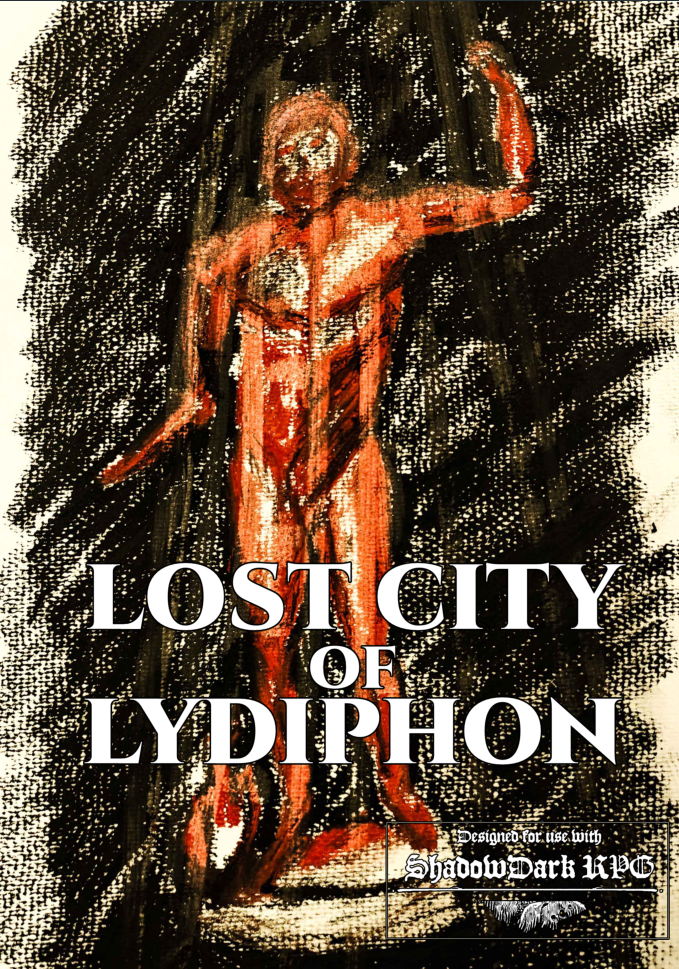
I’m going to start with, this was requested & I passed it by multiple times because I judged the book by its cover. It’s ugly. It’s the most beautiful thing.
What do I mean? The art is not for me. It looks like oil pastel. I’m probably wrong. It has hand-drawn maps that aren’t value corrected, the fonts are an assortment of sizes that are a visual imbalance, & it features kobolds (a monster I dislike for stupid reasons). It’s not refined the way many would probably expect. I should dislike this for so many superficial reasons.
And yet, it adds up to so much personality. It isn’t afraid to be itself. It’s flaws are part of its charm. It focused on being a good adventure first. Honestly, more people should seek being good first. Not filled with bought art. Art doesn’t make your adventure better.
Heart does.
This has heart.
What is it?
A Shadowdark dungeon by Chris Wilson, who did the writing, editing, illustration, cartography, & layout (using the Classic Explorer Template by Explorers Design). Thirty keyed areas across five zones: the Entrance, the Stingbat Caverns, the Kobold Caverns, the Rocktopus Domain, & the Gate of the Triarchs. It’s pitched as the entrance level to a megadungeon, with two ways down.
It says it runs fine with just the Quickstart. That’s helpful for new GMs & people unsure about Shadowdark. It keeps the investment low.
Unique Features?
Mechanically, it’s fairly straight-forward. I don’t recall any unique mechanics.
What’s the story?
An ancient city was magically moved into a system of lava tubes. Badly. Bodies fused into walls. Marble buildings are fused into black volcanic rock. The transported people are mostly forgotten. (Quite literally an example of Shadowdark’s ethos that magic is dangerous.) Kobolds reside here now.
The clan is split over whether stones can grow on trees. Every kobold you meet wants your opinion, and your answer shifts the reaction roll by 2 either way. It’s silly, it’s a faction war, and it’s a puzzle all at once. It’s great. Especially since they have greater issues.
There are two entrances to a deeper dungeon (a megadungeon?) within the kobolds’ new territory. A gatehouse they can’t enter and a rocktopus’s lair. It’s exactly what you think it is. I immediately thought, that’s a cool pokemon idea.
So… Adventure?
Setup
We get 4 reasons to visit the dungeon, plus 3 additional quests you can pickup once inside. The outside hooks are all patrons who want something specific (guano, a working construct, Lydiphon tech, new entrances), which gives the players reasons to come back. Minor nitpick, I would like some non-patron based hooks, but there’s variety within them.
The inside quests come from kobolds, including a child who lost his pet rock. I recommend giving it a silly name. Like branch or leaf.
There’s a d10 rumor table. Thank you. They aren’t marked for their truth though so interpretation & prep is required to figure it out. Few people apply the truth to rumors. More people should.
Every zone has its own d6 encounter table and its own danger level (Risky, check every 2 rounds, or Unsafe in the kobold caves). Variety is the spice of life. I don’t think many designer have adopted creating variety based on the area or zone, but it makes things feel alive. It’s a small thing. It’s smart though.
The Rocktopus shows up on two tables, and it’s LV 5 against level 1-2 PCs. The book tells you outright that it and the LV 6 guardian construct “are intended to be avoided, outsmarted or returned to later.” I appreciate the honesty. And that maps closely to an adventure that is labelled as risky or unsafe.
Room Keys

Every room opens with a block of what you see, with the details in parentheses: “Black volcanic rock (walls and floor). Pool of dark water (extends 20′ into the chamber from northern exit).” Then the interactions follow as “Inspecting the statue reveals…” or “Examining the altar reveals…” That’s obvious first, then hidden. It’s clean. I do prefer a bit more description in sentences, but this wasn’t the early Arcane Library structure so I understand not everyone does it.
Creatures get their own centered caps line with a Reaction note right under it. That tells you what they’re doing when the PCs walk in, which is so incredibly helpful. Again, it’s a different format to something I would typically do since I do Wants, Goals, Secrets, but I found the blocks solid enough I could break it down into something I could use.
Levers:
- The kobold feud. Each kobold group has a side, written into the room. You can play them against each other, end it, or exploit it. I favor turning them into plushies your group sells at market. It’s the real loot of this adventure. (I will not apologize for my dislike of kobolds.)
- The constructs. They still do their jobs. They can be pushed, repaired, taken apart, and sold. There’s a whole engineering problem hiding in this dungeon. Let’s be real though, players will try to make a mech suit.
- Mahoun the hermit. An NPC who wants something specific & knows something useful, with no quest marker over his head.
- The Disassembler (Area 25). How could this not be an interesting thing. It has a cool name. The Disassembler. What does it do? Disassembles. What kind of things? Yes.
Some rooms are quiet. The Kobold Den (13), the Storeroom (16), & the Stairs Down (30) are mostly description, though they all fit the place. I’d still give each one something to poke.
The epilogue is great. It walks through what changes depending on what the PCs did: the feud ending, the Rocktopus dying, the kobolds being wiped out. That’s the dungeon as an ecosystem. More adventures need a concluding the adventure section.
So who is this for?
In general, I think it’s a fairly solid adventure that anyone can run & enjoy. There’s a lot here to help you integrate it into your campaign or setting without being too much that you should run it in the author’s world. Which is a skill I do not have in my own writing.
It’s designed to be a living dungeon & a lot of it is enjoyable if you lean into that. It does require a little more prep work than trying to run it from the page, but I think the tradeoff is worth it. It’s a good fit for a new campaign, and it’d suit a group that likes talking as much as fighting.
If you made it this far, thank you. Now, I’m going to nitpick & nerd out on design. You have been warned.
Design Nitpicks
It’s built on the Classic Explorer Template, not Shadowdark trade dress. Parchment backgrounds, a classic serif, hand-drawn maps, and the author’s own illustrations. It looks like an old module someone loved. It’s a template, so it’s not quite “doing your own thing,” but the art and maps make it the author’s. In general, the biggest win is that it’s not the SD templates. That alone is personality on the page.
For me, there’s a few design choices that probably should be reconsidered (I believe they’re the template’s design choices so I’m not holding it against the creator): fonts, font sizes, colors, etc. It’s not that they are bad, but they are imbalanced. For instance, for good visual clarity, you tend to want to use a 1:(1.4-1.6) ratio of body text to sub-header. Then, 1:(1.4-1.6) sub-header to header. Your line spacing typically follows a similar ratio. So the body text is a 10, your sub-header is 14-16 points, & the leading is 14-16 points. And so on. Again, this is a template issue more than anything. Not faulting the author for using it.
Map placement. Every zone opens with its intro and encounter table, then a key list facing a full-page map, then the rooms. Map before keys, every time. And breaking the dungeon into zones means each map is small enough to read. Love it.
DCs. Mostly standard: DC 12 shows up the most. There’s a DC 14 on a spore cloud in the Gate encounters. One check (gathering guano) is a “DC12 CON save.” It’s a check, not a save. Again, it’s mostly correct, but a few slip through the cracks.
x:6 chances. A lot of things run on “2:6 chance,” “4:6 chance,” “3:6 chance.” That’s an OSE/B/X habit. It works, but Shadowdark would just make most of these checks or a straight call. The rope ladder (“X:6 chance it breaks… where X is the number of people”) is the best one, because it’s clever and has a cost. Keep that one. You can probably lose most of the others or just set it to the decider die.
Treasure XP. Magic items have XP noted (“Potion of Flying… (3 XP)”). Thank you! But coin and art treasure (the 127g in the lair, the urn, the painting) doesn’t. I’ll forgive coin as 100g = 1 XP, but I do think authors should mention 100g = 1XP somewhere at least once.
Monster math. All stats are in the back (pp. 45-47). Fine, but since there are no links, that’s a flip every fight. The guardian construct has Ch +2, which made me laugh. It’s Wall-E & EVA. Cute constructs.
Page numbers & bookmarks. Page numbers and a table of contents. No bookmarks or links. For a 48-page dungeon you flip around in, I want them.
Art & credits. All art is credited to Chris Wilson. The hand-drawn maps are lovely. Art is subjective, some people will love it. Some will hate it. It took a chance and did something outside the normal black & white ink drawings. That deserves credit.
Leave a Reply