

The Cursed Knights of Crestmoor can be found on LowKeyTTRPG’s itch.io for PWYW. $2 is a reasonable price.
~2600 words. 13 minutes read.
After our foray into settings, we’re back to exploring starting adventures. Something low key. I admit, I saw LowKeyTTRPG posting about this in the Discord and a few others commenting on it, & found myself intrigued.
What is it?
This is a Shadowdark location adventure for level 1 characters set in a decrepit tomb dedicated to the brave knights that slayed a malevolent black dragon now overrun by kobolds & lizardfolks. It’s got a little bit of everything classic you expect & a few things you don’t.
Unique Features?
It doesn’t follow the Shadowdark formatting. (YAY!) And has a video about how to run it (here) since it is from youtuber, LowKeyTTRPG. It’s about as new GM friendly as you can get.)
What’s the story?
Sir Galen & his merry band of knights slew a great black dragon. They were buried in this magnificent tomb. Kobolds moved in. Then, lizardfolk took over trying to locate Sir Galen’s magical Fireblade. Even Sir Galen’s corpse is moving a bit.
So… Adventure?
This is a location-based adventure. All of the story centers around this location, but the players can choose how they want to engage with it. This is where you would typically see in an OSE module about how players can decline to engage in an adventure. For a long time, I always thought, “duh” and also, “why would they refuse to engage in an adventure that was set up for them?” But, with experience, it really means, they don’t have to engage in every story element within the location and there’s no need to railroad people into exploring the full story.
This never comes up in this starting adventure, but since there is a note in the Adventure Hooks section about first time players, this might be something that should be pointed out, because location-based adventures aren’t very common in other systems. It’s kind of a unique element of dungeon crawl play that is popular in the OSR, but less popular when you branch out further into 5e and others. I bring it up only because a lot of people seem to think of Shadowdark (SD) as 5e-lite and I think the simple story is approachable for new GMs who may not be aware that it’s okay to leave stones unturned.
Hooks
There are 2 very simple story hooks. They aren’t the strongest. One is about a missing wedding band and the other about stolen tools – both good low level problems that are approachable, but they are less engaging for an older audience. Neither plays on the power fantasy or treasure motivation that you commonly see for dungeon crawls. I find that a bit intriguing as it makes the adventure more approachable for families to use to engage their younger children. You can use it as a moral teaching moment, but it also distances itself from the system’s core identity as well. I do wish it had some of the classic hooks covered.
Rumors
There is a simple explanation of what rumors are, which I think is helpful for new GMs, but not necessarily what their purpose is. For me, I find the WHY more informative than the WHAT when I’m trying to learn a new system or skill (as a GM), but it certainly does more than Lost Citadel does in explaining rumors, but Lost Citadel also gets to lean upon the Quickstart rules some.
The reason I bring up the WHY versus WHAT issue is because many of the rumors provide lore, provide motivations, but don’t really provide actionable information to prepare you for the dungeon. Joseph R. Lewis on Hooks & Rumors discusses rumors as a thing you use to give players actionable information about where to go and what to do. I also like to include, any potential unique risks that they might want to prepare for.
Here, the where to go is pretty solidly laid out as Sir Galen’s Tomb. I would use asking people around town about where Sir Galen’s Tomb as the opportunity for those individuals to mention a rumor as well. This would have been a good example opportunity of how to use rumors, but it provides some other examples to teach the GM.
Random Encounters
Again, how the mechanic works & references to the rules are cited. Great help to new GMs. It does neglect to mention reaction rolls or distance rolls, but I think the reference to the rules covers that somewhat. It mentions that the environment is “unsafe” (check every 3 rounds) and the encounters themselves feel unsafe rather than deadly. It’s a nice touch.
The encounter blocks seem rather large, but that’s because the monster statblocks are included in them. There are some adoptions of some of the re-organized statblock that I tend to advocate since it makes it easier to parse at the table. Although, RIZ or Z instead of CHA would have absolutely sold me. Small victories. (I also feel like there’s a subtle nod to Rudeus Greyrat here, but it’s stretched just enough that it may be a coincidence.)
The 8th random encounter is pretty hefty so I’d read it before hand so you can plan accordingly. Basically, the former leader of the Kobolds breaks free & tries to recruit resistors to the Lizardfolk (possibly the players). I almost feel like this should just be a planned encounter for one of the rooms (maybe an additional room) instead of a random encounter. It’s a bit of good faction play hidden behind the gate of random encounters. Which, given the size of this adventuring tomb, is unlikely to come up with random encounters every 3 turns. That’s a shame because it limits the interactivity within the dungeon.
THE TOMB
We are first introduced to the tomb via the map. It includes no key while using some classic symbols that may not be familiar to new GMs. It also uses lettering rather than numbering to code the rooms, while using a numeric for hallways/passages. I’m used to the inverse so that threw me off a little bit. It also never explains that red = room and blue = hallway/passages and it didn’t click for me right away. Finally, the map shows 2 entrances, but does not provide any detail on how to find the second.
For a new GM, linear stories/paths are easier to understand intuitively. Things that break from the linear approach, need a little explanation of how to adjudicate it. One of the things I love about Tomb Robbers of the Crystal Frontier is how clearly it explains the different entrance approaches before it even starts the room keys. It’s basically a step-by-step guide of how to address several elements including finding & entering the dungeon from the 2 possible entrances. The lack of that here, along with the odd room key route can trip up any new GM the way it makes someone with a bit of experience quirk an eyebrow and go, “huh?”
Some improved clarity in the organization & presentation would go a long way in making the map & approach easier to parse for a new GM.
Room Keys
I’ll say it up front, I don’t understand why everything is a bullet point on the room keys. As a GM, I want room key text to be written in a manner that tells me what the players immediately see upon entering the space. It can be provided as short descriptions like Lost Citadel or as sentences like Library of Leng (Cursed Scroll #5). I want the elements that have more details about them bolded so I know to go look for them in the bullet point section later. Typically, this is where you want the hidden information, with secrets underneath, as a subset, or it’s own section afterwards. Basically, I want a hierarchy of immediacy & interaction.
Even if you don’t adhere to my preference: New School Revolution & His Majesty The Worm’s design course have alternatives. Both provide slightly different best practices for presenting information in the room key that I think would so greatly enhance these. Because, as written, these room keys are difficult for a new GM to grasp the scope of what is being presented in terms of most important, visible, hidden, or secretive.
What do I mean?

I’m going to notice Kobolds before I notice ill-tended rows of onions or even the entrance to the tomb. Yet, the most important & immediately visible element of this room key is last. This becomes a worse issue in the second room key where there are 8 bullet points to explain there is a broken crate, a stone vessel with water in it (that can heal), & 2 doors. If I can summarize 8 bullet points into less than 20 words, there is an organizational issue or a lot of unactionable language.
That said, I’m going to presume there’s a logic behind this organizational structure which is to provide step-by-step descriptors of entering the space so we can see the doors (no mention of the stone vessel between them though), then explain the broken crate so we can find some stoppered bottles & a flask of oil, before we get to the water so we have something to fill with the holy water, and then we find out it is holy water. It seems like the intention to was the GM through a possible approach to rewarding this treasure of holy water through slow reveal that the GM should use for the players. But as a GM, even a new one, I want to understand first, then present. If I rewrote this for a new GM, it would look something like this:
(b) ENTRY
Stone stairs descend into a lightless room. Two doors straddle a faucet dripping water into a stone vessel on the opposite wall. In the corner, is a splintered crate. Roots dangle from cracks in the ceiling.
- Doors. Heavy wooden doors with steel bands. Left leads to Overgrown Hall (1) & onto King’s Chamber (c). Right leads to junction where continues to King’s Chamber (c) or turns into Squire’s Crypt (d).
- Stone vessel. Pure cold water drips into. Inscription on wall above it reads “with this water, the worthy are blessed.”
- Filling a bottle counts as Potion of Healing. +1d4 if lawful.
- Splintered Crate. Contains … lantern oil, & 2 dusty stoppered bottles.
- Bottles are empty & can be used to collect cold water from the vessel after wiping the dust clean.
Using roughly the same number of words, we’ve added extensive details about the exits & directions they lead, provided clarity on what’s immediately visible/important, and added details about a few interactions to guide our new GM on how they may want to encourage players to use some things or rule on others. Additionally, we’ve reduced the cognitive load on the new GM, with the organization & simplifying it to the 3 core elements of the room rather than retaining the bullet point list structure it currently has that treats all information as equally important.
Aside from this, all of the room keys are interesting (I don’t understand the bolding structure used though). There seem to be a sufficient amount of things to interact with. There’s an interaction with the torch timer that might be a little clunky. I’m not really sure how a new GM would handle it, because at a certain point 5 or 7 minutes may not be worth micromanaging? I’m not sure. There’s probably a more elegant solution, I just can’t think of one. We’re told in passage 2 that the halls are much higher, but we were never told what the height was beforehand so I’m not really sure what “much higher” means.
All in all, there’s a lot of fun to be had with the kobolds, lizardfolk, & tomb that would benefit from a stronger organizational structure on the room keys.
Appendices
There are 3 and they flesh out the adventure a bit more. Personally, I want this information in the setup. NPCs & Factions – give them to me before I run the game, not as an afterthought. The treasure table with suggested XP rewards harkens to OSE styling and is a good way to teach new GMs. I’m more on the award XP while playing bandwagon so I’d prefer to see the XP awards in the room keys.
So who is this for?
This is a solid, simple adventure where a lot of fun can be had. It’s presented in a lighter tone than SD’s grim/dark fantasy vibes so it’s a lot easier to use it with younger audiences. Overall, it does a fairly good job introducing a new audience to SD and coaches them through it. It’s a shame the map & room keys aren’t also teaching tools like the rest of the adventure. It’s almost there.
Since it’s a smaller location, I imagine a party of 4 could burn through this in a single session of 3-4 hours with relative ease. Things are fairly straightforward & simple with a decent amount of room for a good GM to make it sing while a new GM has enough to build upon. There’s also a video linked at the start that walks a GM through the adventure. It’s an hour long. Such a useful tool for coaching new GMs. Unfortunately, I think it explains some of the room descriptions better than the room keys do.
If you made it this far, thank you. Now, I’m going to nitpick & nerd out on design. You have been warned.
Lay it out like you want it to be re(a)d.
First, I love the color-coding. Smart use of color is a great way to train new people how to read the adventure & run it. The problem arises when things do not align to the color coding you establish. What I mean, is once you introduce a color-coding system, those color codes are no longer accent colors. Here, if you want to maintain the accent color and lose the color coding, the blue circles for the numbered hallway/passage keys should just be a red number, black (or no) circle.
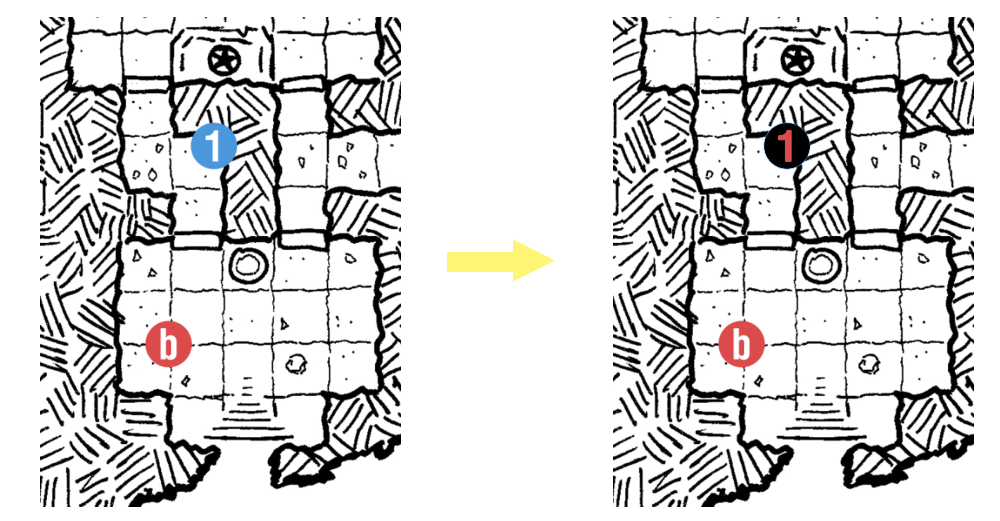
By swapping it to an accent color, we remove the coding information that isn’t carried throughout the adventure. It makes it easier to recognize that red isn’t significant, it’s just an accent. Then, when we see red bolding, we don’t think it’s tied to a specific red code, but rather, is just meant to draw our attention to that piece of information.
Second, layout could help in that regard as well. I already went into the room keys a little bit, but I also think divorcing yourself from the 2 column spread would help since there are multiple instances where column 1 overflows into column 2, which I generally dislike because it slows reading and running at the table from the book. Is it a significant issue? No, not compared overflow to the next page. It’s not particularly noticeable given the way bullet points are used to break up the writing, but since I’m suggesting this would benefit from a 2/3rd page column with monster stat blocks and maps in the 1/3rd margin, I figure I should mention careful consideration of overflow.
Third, have a system behind the bolding. Otherwise, the bold & color starts to lose its focus & blurs into the rest of the text. 1-2 every bullet point is too much. The information starts to run together as a result. Changing the organization will convey the same importance by providing a hierarchy (as demonstrated above) with less visual noise & clutter. It’ll make it definitely easier to read.
All in all, it’s simple & clean. A few of these changes would make this one of the best starting adventures out there to use as a teaching tools for new GMs.

Leave a Reply